
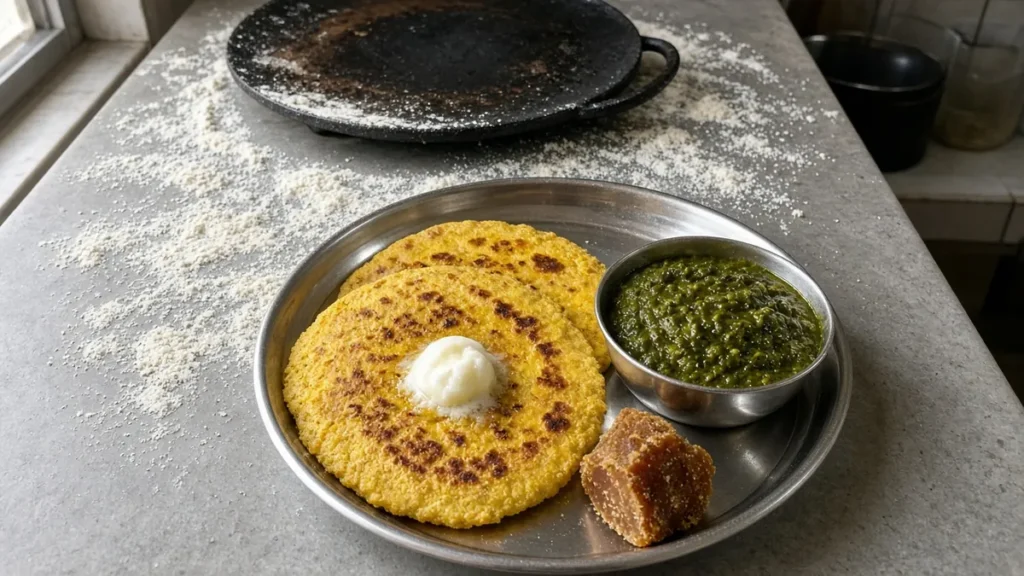
Makka ki roti is the winter bread of North India, and it is famous for one problem: it cracks and breaks the moment you try to roll it. This makka ki roti recipe shows you how to knead the dough, shape the roti by hand or with a plastic sheet, and cook it on a tawa so it comes out soft and whole. All you need is fresh Makka Ka Atta, warm water, a pinch of salt and a little patience. At Nath Mills in Tanda we grind Makka on our chakki, and this is the method most homes in our area follow.
Makka ki roti recipe: ingredients
This makes 6 to 7 medium rotis, enough for three people with sarson ka saag.
| Ingredient | Quantity |
|---|---|
| Makka Ka Atta | 2 cups (about 250 g) |
| Warm water | 3/4 cup to 1 cup, as needed |
| Salt | 1/4 teaspoon |
| Wheat atta (optional, for easier rolling) | 2 to 3 tablespoons |
| Ghee or white butter | to serve |
| Carom seeds (ajwain) | a pinch (optional) |
Kitchen tools: a parat or large bowl, a tawa, a clean cotton cloth, and a plastic sheet or butter paper (cut open a clean zip bag if you have one).
Why makka roti breaks
Maize flour does not stretch, so the dough does not hold together the way wheat dough does. That is why it cracks at the edges. Three things fix most of the trouble:
- Warm water. It softens the flour and helps it bind.
- Kneading one roti at a time. Makka dough dries out quickly, so knead a small portion just before you shape each roti.
- Shaping by hand or between sheets, not with a belan on a dry board.
Step-by-step method
1. Mix the flour
Add the Makka Ka Atta, salt and ajwain to a parat. If you are new to making makka roti, add two or three tablespoons of wheat atta. It makes the dough easier to handle. Our Usha Bhog chakki atta works well for this.
2. Add warm water slowly
Pour in warm water a little at a time and mix with your fingers. The flour will look crumbly at first. Keep adding water until it comes together into a soft, slightly sticky dough.
3. Knead with the heel of your palm
This is the key step. Take a portion the size of a large lemon and knead it on the parat with the heel of your palm for one to two minutes. Press, spread and gather it again. The dough becomes smooth and soft. Keep the rest of the dough covered with a damp cloth.
4. Shape the roti
Hand method: wet your palms lightly. Place the dough ball between your palms and pat it, turning it a little each time, until it is about 5 to 6 inches wide and a bit thicker than a wheat roti.
Sheet method: place the ball on a greased plastic sheet, cover it with another sheet and press it gently with your fingers or the flat base of a plate. Peel off the top sheet, flip the roti onto your palm, and remove the second sheet.
If the edges crack, pinch them together with a wet finger.
5. Cook on the tawa
Heat the tawa on medium. Place the roti on it and cook for about one minute, until small spots appear underneath. Flip and cook the other side. Makka rotis take a little longer than wheat rotis, so keep the heat at medium, not high.
6. Finish over flame or on the tawa
Press the roti gently with a cloth on the tawa until it puffs in places, or hold it over a direct flame with tongs for a few seconds. Rub ghee or white butter on top and serve hot.
Tips for soft makka ki roti
- Use fresh flour. Fresh chakki-ground maize flour binds better than old flour, which can taste bitter and crack more.
- Knead each portion just before cooking. Dough left out turns dry within minutes.
- Keep the roti a little thick. Very thin makka rotis break easily.
- Grated radish or methi. Many families mix in finely grated radish or chopped methi leaves. The moisture helps the dough bind and adds flavour.
- Wrap in a cloth. Stack cooked rotis in a cotton cloth inside a casserole so they stay soft.
Common problems and fixes
| Problem | Likely cause | Fix |
|---|---|---|
| Roti cracks at the edges | Dough too dry or not kneaded enough | Add warm water and knead with your palm |
| Roti sticks to hands | Dough too wet | Add a spoon of flour; wet palms only lightly |
| Roti stays raw inside | Too thick or heat too high | Pat thinner and cook on medium heat |
| Roti turns hard after cooling | Cooked too long or not covered | Apply ghee and wrap in a cloth at once |
What to serve with makka ki roti
The classic pair is sarson ka saag with a spoon of white butter and a piece of gud. It also goes well with:
- Aloo or gobhi sabzi
- Bathua raita or plain curd
- Green chutney and pickle
- Masoor or arhar dal
For more winter dishes, read our Makka Ka Atta guide, which covers other uses for maize flour.
How to store Makka Ka Atta
Maize flour stays fresh for a shorter time than wheat atta. Keep it in an airtight jar in a cool, dry place and use it within a few weeks of opening. Buying smaller packs through the winter is a good idea, so the flour is always fresh when you cook.
Buy Makka Ka Atta from Nath Mills
Our Makka Ka Atta is chakki-milled from maize at our mill in Rampur Kalan, Tanda, with no added preservatives. Prices listed on nathmills.in:
| Pack | Price |
|---|---|
| 500 g | ₹30 |
| 1 kg | ₹60 |
| 2 kg | ₹120 |
| 5 kg | ₹299 |
A 1 kg pack makes about 25 to 28 medium rotis. Pair it with our Chawal Ka Aata for winter favourites like fara.
Frequently asked questions
How do I stop makka ki roti from breaking?
Use warm water, knead each portion with your palm just before shaping, and pat it by hand or between plastic sheets instead of rolling it.
Can I mix wheat atta with makka atta?
Yes. Two or three tablespoons of wheat atta per two cups of Makka Ka Atta make the dough easier to shape.
Should I use hot or cold water for makka dough?
Use warm water. It helps the maize flour bind into a soft dough.
How many rotis does 1 kg Makka Ka Atta make?
About 25 to 28 medium rotis, depending on size.
How can I order Makka Ka Atta from Nath Mills?
Order on nathmills.in, call +91 95111 45377 or +91 73985 16177, or email nathmills0.1@gmail.com.
Contact Nath Mills
Visit us at 129, Rampur Kalan, Tanda, Ambedkar Nagar, Uttar Pradesh 224190. Call +91 95111 45377 or +91 73985 16177, or email nathmills0.1@gmail.com. Enjoy your winter cooking!